
Martial arts billing goes wrong when fees live in one place and everything else lives somewhere else. Membership status sits in a spreadsheet, attendance on a clipboard, grading fees in a text thread. The fix is to bill from the same student record that holds attendance, membership and grading data. Bakudo is built that way for martial arts clubs, so fees, students and classes are managed in one place rather than reconciled by hand each month.
This guide covers what clubs actually have to bill, what an invoice must show, how to handle failed payments and cancellations, and what to look for in club invoice management software.
TL;DR
- Most clubs bill five things: recurring memberships, class packages, private lessons, grading and tournament fees, and gear. Each behaves differently, so keep them on separate lines.
- A clear invoice names the club, the student or guardian, a unique number and date, itemized charges, the total due and the payment terms.
- Failed cards, late payers and cancellations need written rules before you need them. Decide the policy once, then apply it the same way to every family.
- Billing works best when it is connected to attendance and memberships, so you never bill someone who left or miss someone who is still training.
- Daily backups and the ability to export your data matter as much as features, because billing records have to be kept for years.
Table of Contents
- What martial arts clubs actually have to bill
- What a club invoice should include
- Set your billing rules before the first payment
- A billing routine that takes minutes, not evenings
- Connecting billing to attendance and updates
- Choosing club invoice management software
- How Bakudo fits
- FAQ
- Sources
What martial arts clubs actually have to bill
A club's income rarely comes from one neat monthly fee. Look at a typical year and you will find several kinds of charges, each with its own rhythm.
Recurring memberships. A monthly or term fee, often with a family discount for siblings or a parent training alongside a child. This is the bulk of revenue and the part that most needs to be automatic.
Class packages. A set number of sessions for people with irregular schedules, usually with an expiry window. These need a count of sessions used, which is attendance data.
Private lessons. Billed per session or in blocks, with their own cancellation terms.
Grading, seminar and tournament fees. One-off charges tied to an event. They arrive in clusters, a few times a year, and they are the ones most often forgotten or collected in cash with no record.
Equipment. Uniforms, belts, gloves and protective gear. These are products, not instruction, and are often treated differently for tax purposes (more on that below).
When all five sit in different notebooks, you cannot answer simple questions: who owes what, who has not paid since September, which family paid a grading fee but never entered the test. Bakudo is designed to manage memberships, fees, finances, gradings, tournament entries, private lessons and equipment orders in one system, so these questions have one place to be answered. Its membership tracking is where recurring plans live.
What a club invoice should include
A written invoice is what a parent can file, what a sponsor or school fund may ask for, and what you rely on if a payment is disputed. A guide to martial arts instructor invoices lists the elements most clubs need:
- the dojo or business name
- the student's or guardian's details
- a unique invoice number and an invoice date
- itemized lines for sessions, packages, grading or seminar fees, with unit rate and quantity
- any deposit already applied
- tax, if it applies
- the total due, payment terms and accepted payment methods
The same guide suggests net 14 days for families and net 30 for corporate clients, which is a sensible starting point for a club that invoices both parents and, say, a company running a self-defense workshop.
Keep tuition and products on separate lines
Class tuition is a teaching service. A gi or a pair of gloves is a product. Splitting them on the invoice keeps the record clean and makes any tax treatment easier to apply. The guide above notes that sports instruction may be exempt or zero-rated in some jurisdictions while product sales are more commonly taxable.
US rules depend on your state
If your club is in the United States, there is no federal invoicing law. Xero's US invoicing guide explains that requirements come from state and local rules covering sales tax, trade names, license numbers and limits on late fees. Before you set a late fee or charge sales tax on equipment, check your state's revenue department and, for anything unusual, ask a local accountant. Clubs elsewhere should check their own tax authority: in the UK, for example, GOV.UK sets out what an invoice must contain, including the supply date and a serviceable address for sole traders.

How long to keep records
The Aviy guide notes that tax authorities often require invoices to be kept for five to seven years, depending on where you are. Your accountant can confirm the period that applies to you. What matters for the club is that records stay readable and accessible long after a student has left, which is a reason to value daily backups and a clean export option.
Set your billing rules before the first payment
Most billing friction is not technical. It is the awkward conversation at the front desk because the rule was never written down. Decide these points once and put them in your enrollment terms.
Cancellations and no-shows
Common norms, as described in the instructor invoice guide, include 24 hours' notice to reschedule a private lesson at no charge, late cancellations charged at 50 to 100 percent of the session rate, package sessions expiring after a set window such as 90 days, and memberships requiring 30 days' notice to cancel. Deposits are typically non-refundable inside the cancellation window. These are starting points, not rules: pick numbers your families will find fair and apply them to everyone.
Freezes and family accounts
Martial arts families pause for injury, exams, holidays and travel. Decide how long a freeze can last, whether it is free, and how a freeze affects belt eligibility and attendance requirements. For families with several children, decide whether the discount applies per child or per household, and who receives the invoice.
Late and failed payments
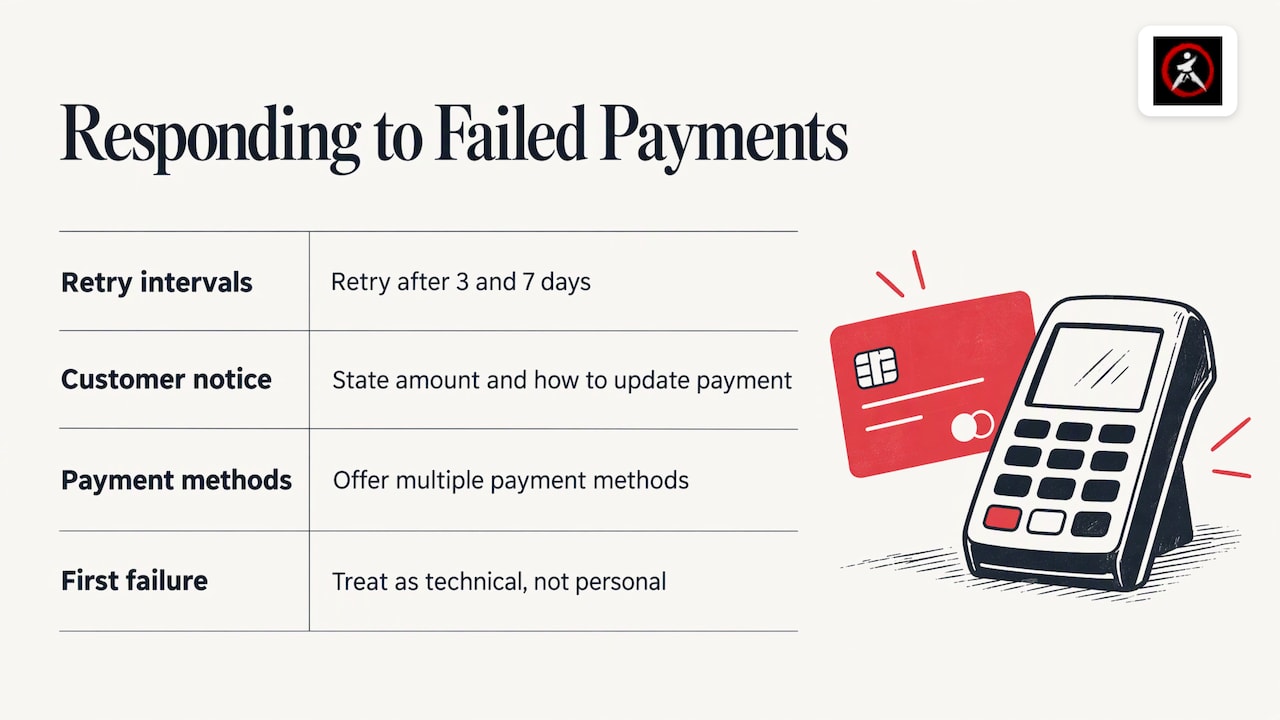
Cards fail for ordinary reasons. Stripe's guide to automated billing lists expired or invalid card details, insufficient funds, bank-imposed limits and technical issues, and recommends retrying at several intervals (for example after three and seven days), notifying the customer clearly and offering more than one payment method. Treat a first failure as a technical problem, not a character judgment. A polite message that includes the amount and how to update payment details resolves most cases.
A billing routine that takes minutes, not evenings
Whether you use software or not, a monthly routine looks like this. Here is where each step usually breaks and what changes when the data is connected.
- Confirm who is active. Start from the current member list. Spreadsheets drift: someone quit in August and still shows as a member in November. Bakudo keeps student records, memberships and fees together, so the list you bill from is the list you teach from.
- Apply plans and discounts. Family rates, package balances and freezes are where manual errors multiply. Keep each plan's terms in the student record rather than in your memory.
- Add one-off charges. Grading fees, seminar fees, tournament entries and equipment orders. Bakudo handles gradings, tournament entries and equipment orders in the same system, so these charges sit beside the student they belong to. Its tournament entry forms fill in from student records, which also removes retyping when entry fees are collected.
- Issue and send. Each invoice needs its own number, date, itemized lines and terms.
- Follow up. Retry failed payments on a schedule and contact late payers early, politely and consistently.
- Reconcile and file. Match what came in against what was due, and keep the records somewhere safe and exportable.
The steps that eat time are the first, second and sixth. They are data problems, not money problems, and they disappear when students, attendance and fees are not split across tools.
Connecting billing to attendance and updates
Billing without attendance is guesswork. Consider three everyday situations.
Class packages. A ten-class pack is only useful if somebody counts the classes. When check-ins feed the package balance, nobody argues about whether a student has two sessions left or four. Bakudo's attendance tracking records who trained and when.
Grading eligibility and fees. Many clubs require a minimum number of classes before a grading. If attendance, belt history and the grading fee are in the same record, the coach sees at a glance who is ready and who has paid. See how belt testing and grading is handled in the same place.
Parents who want to know. Parents ask the same questions every month: did my child attend, what is due, when is the next test. Bakudo supports parent updates, so those answers come from the system instead of from the instructor's phone after class.
There is also a coaching angle. Coaches who need access to student data should see what they need for teaching, such as attendance, belts and medical certificate status, without seeing the whole club's finances. Bakudo includes coach permissions for exactly this split.
Choosing club invoice management software
If you are comparing options, judge them on what happens in your club, not on the length of a feature list. Here is a checklist that matches how martial arts clubs really work.
| What to check | Why it matters for a club |
|---|---|
| Memberships, packages and private lessons in one record | Each student's charges stay together instead of scattered across lists |
| Attendance tied to the student record | Package balances and grading eligibility stay accurate |
| Grading, belt and tournament support | Event fees and entries sit beside the student they belong to |
| Coach permissions | Instructors see teaching data without seeing all finances |
| Parent updates | Fewer questions to the instructor after class |
| Excel import and export | Moving your existing spreadsheets in, and your data out, is straightforward |
| Daily backups and data ownership | Billing records must survive years, and the data should stay yours |
| Mobile access | Check-in and look-ups work on the mats, not only at a desk |
Generic gym tools handle monthly charges but know nothing about belts, stripes, weigh-ins or tournament forms. A martial arts-specific system keeps those pieces together, and the sport-specific pages show how: karate, judo, taekwondo, BJJ and MMA.
Setting up without losing a month
Start with a clean member list from your current spreadsheet and import it through Excel. Then enter plans and family links, add current belts and gradings, and run the first billing cycle alongside your old method. Once the numbers match, retire the spreadsheet. Moving in a quiet month, not just before a grading season, keeps the change calm.
How Bakudo fits
Bakudo is subscription software for martial arts clubs that manages schedules, student records, attendance, memberships, fees, finances, tournament entries, gradings and belt ranks, weight histories, private lessons, equipment orders, medical certificates, insurance, coach permissions and parent updates. It works on mobile, imports and exports Excel files, backs club data up daily, does not share it with third parties and lets you export it at any time. More than 150 users already run their administration this way, and a free trial comes before the recurring club subscription.
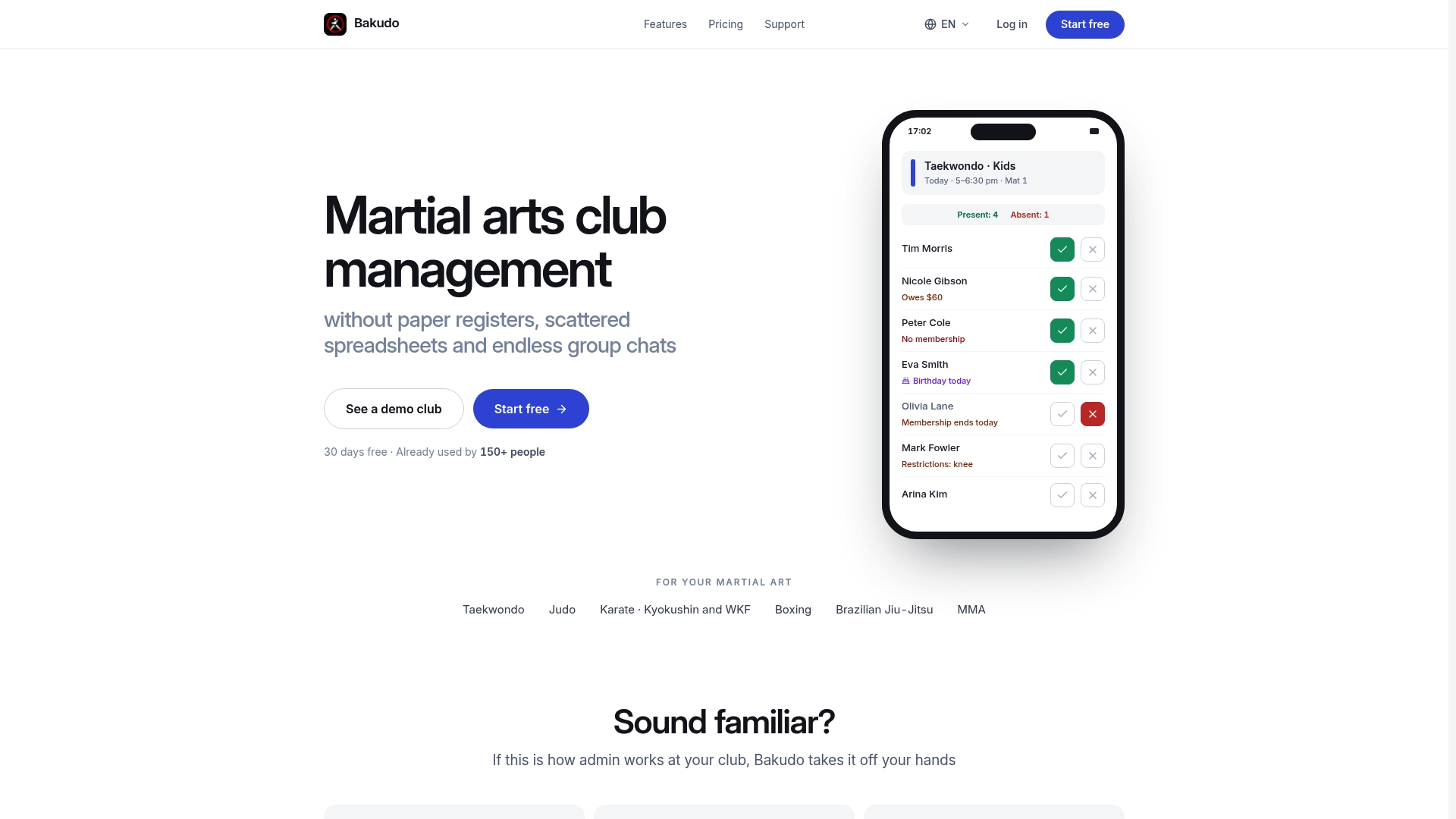
If your billing currently depends on a spreadsheet, a notebook and your own memory, start with the Bakudo student management page and see how your members, fees and classes would look in one place.
FAQ
What should a martial arts invoice include?
The club name, the student or guardian's details, a unique invoice number and date, itemized lines with rate and quantity, any deposit applied, tax if it applies, the total due and the payment terms. Keep tuition and equipment on separate lines.
How do I handle a failed membership payment?
Treat it as a technical issue first. Cards expire and banks apply limits, so retry after a few days, send a clear message with the amount and how to update payment details, and apply the same policy to every family.
Do US martial arts schools have to charge sales tax?
It depends on your state. There is no federal invoicing law in the US, and sales tax, license numbers and late-fee limits are set at state and local level, so confirm the rules with your state revenue department or an accountant. Tuition and equipment are often treated differently.
How long should a club keep billing records?
Tax authorities commonly require invoices to be kept for several years, often five to seven according to one invoicing guide, but the period depends on where you are. Confirm yours with your accountant and keep records in a system with backups and export.
Sources
- Martial Arts Instructor Invoice Template: Free Guide
- What to include on an invoice (Xero, US)
- Invoices: what they must include (GOV.UK)
- A guide to using an automated billing system for gyms (Stripe)